
The Englorification Movement has arrived - and it's buying Letterboxd!
ELIZABETH JOYCE has a bold plan to rescue the film discovery platform from Wall Street's M&A wood chipper - and hand ownership to the film community. Will it work?

“Just when you thought all these young people who grew up on TikTok are done with movies, it turns out they like to go with their friends.
The theatrical film experience has been under threat for 80 years, and it always withstands the ups and downs because we are communal beings.”
Tastemaking is a delicate trade.
In 2011, two web designers from New Zealand built a platform for film tastemaking - and proved it could also be a lucrative one.
Letterboxd allows movie lovers to log, rate, and review films, while sharing curated lists with others. Since its rapid ascent during the pandemic, it has played a significant role in facilitating film discovery and enthusiasm, particularly among younger Millennials and Gen Z - now the most active moviegoing cohort. It is, in this day and age, the rarest of things: a vibrant new cultural institution.
Over the years, co-founders Matthew Buchanan and Karl von Randow have declined buyout offers, maintaining their commitment “to stay independent from the industry,” as co-founder Matt Buchanan told Variety. It served them well: By 2023, Letterboxd had 10 million registered users.
That same year, the founders sold a controlling stake to Tiny, a Canadian investment firm that prides itself on letting its businesses run without interference. Again, the strategy paid off: Letterboxd’s user base has now grown to 30 million registered members.
On April 26, Tiny announced plans to sell its stake in Letterboxd at a valuation of $250 million. Last week, Puck reported that private equity firms RedBird Capital and TPG are already circling, alongside Netflix, Sony, and (surprise) Paramount. Devoted users fretted, and understandably so: The internet is a graveyard of once-beloved communities (MySpace, Tumblr, Twitter) whose delicate ecosystems were poisoned by incompatible corporate interests. Letterboxd, it seemed, was doomed.
Enter Elizabeth Joyce, a Boston-based screenwriter and economist who spent the last few decades developing alternative business models. With support from Harvard Law School and others, Joyce founded a “public benefit company,” which rests on a middle ground between unregulated predatory capitalism and donor-dependent philanthropy. Intrinsic Entertainment Collaborative is devoted to finding sustainable mission-driven profitability in the film industry.
Today on Underexposed, Elizabeth stops by to answer some questions about the campaign, why englorification is the answer to enshittification, and why this fight isn’t as impossible as it sounds to win.
Underexposed is a weekly ad-free film publication celebrating great underseen cinema and moviegoing culture. Paid subscribers get exclusive essays, videos, and more - while supporting the future of movie culture.
Alex Rollins Berg: I’m intrigued by your mission to buy Letterboxd, and wholeheartedly supportive of this bold, courageous endeavor. But naturally, I have questions. Firstly, for those who don’t know: Who are you, Elizabeth Joyce? How did you get interested in building alternative business models for film?
Elizabeth Joyce: I went to NYU intending to study film and human rights policy. By sophomore year I had an internship at Human Rights Watch that turned into a job and what felt like a real career path. I also knew I wasn’t moving to LA and probably couldn’t afford to stay in New York once loan payments kicked in! As a hobby I assisted with impact campaigns and made a documentary short about some older gentlemen who take quaaludes and do something we could call “yoga-adjacent” in a community garden in the middle of downtown Boston. It still brings me endless delight.
I worked for many years in nonprofits and academia and kept bumping up against the same problems: how to fund mission-driven work sustainably, and how to break out to a wider audience than just your fellow academics and activists. Those questions around how to make the economics of activism and art sustainable were really present in all phases of my career, and led me to social entrepreneurship in 2012. I incorporated one of Massachusetts’ first public benefit corporations in 2013 and ran it until 2020. In March 2020 I was 8 ½ months pregnant and I felt ready to explore filmmaking professionally. Then I discovered that my passions of economics and filmmaking were actually much more mutually relevant than I had ever realized.
As I started really studying the economics of independent filmmaking, I realized the work I had done on alternative business models was just as relevant for filmmakers as it was for social entrepreneurs. It really lit a flame for me to realize I could combine my two favorite topics and utilize my specific area of nerdy expertise to benefit the people making the films I adore.
Alex Rollins Berg: What are the biggest problems facing independent films in the age of streaming platforms?
Elizabeth Joyce: Where to begin! We have a long list of structural problems created by overlapping societal-level issues, by which I mean the convergence of a global pandemic with what is essentially a new industrial revolution, in that the modes of production, distribution, and marketing have fundamentally changed.
I think this is different from a cyclical downturn. I remember hearing people say “stay alive ‘til 25” during the pandemic, as if in 2025 things would revert to the way they were before. Reversions happen when an industry is experiencing cycles, but I don’t think we’re ever going back. We have to create something new out of the ashes of what no longer exists.
We can look at any number of individual problems – the decline in acquisitions, the compression of theatrical windows, the hoarding of viewership data by the streamers themselves, single fee agreements with no backend participation, the flood of slop that makes it genuinely hard to sort through infinite generic options to discover new films, I could go on… but I think this really is sort of a new industrial revolution we are living through in which we are seeing that the old modes of production, distribution, and marketing are not coming back, and we are building the new plane as we fly it.
I don’t want to just focus on the problems though, because there is also an enormous opportunity in front of us to build something better instead of rebuilding the old stuff that wasn’t very equitable anyway.
What I’m excited about are the new models coming into focus. The ability to self-distribute films on platforms like Kinema. I’m excited about Community Center, the collaborative marketing platform Intrinsic has been building since before also pursuing the acquisition, that will allow filmmakers to build relationships and share audiences with small businesses and affinity groups who care about the thematic issues in a film. I am genuinely very hopeful about where we are headed, while simultaneously experiencing the same challenges we are all facing around surviving the time where the end of the old era overlaps with the beginning of the new.
The thing that helps me keep pushing forward is remembering that all those issues I listed are not a random collection of unrelated problems that are popping up like whack-a-mole. They are interconnected. They are problems created by the pathology of late-stage capitalism, which is to “optimize for efficiency” until the point it becomes incompatible with human life or healthy societies. Intrinsic wants to optimize for quality of human life.
Alex Rollins Berg: “Letterboxd is the biggest asset we could have in independent film,” is something you recently said. Tell us about its unique significance, as well as your relationship with the company.
Elizabeth Joyce: The unique significance of Letterboxd is that it is a community of nearly 30 million film lovers, built organically over a 15 year period, and that those users regularly create momentum around films both new and old. Letterboxd users are quick to embrace new independent films from around the world, and they also breathe new life into older films. For independent filmmakers that can mean the resurfacing of older work alongside new work, and the ability to market our films in the most cost-effective way possible.
Jon Reiss did a case study with one of the producers of Hundreds of Beavers about how they did $2500 worth of extremely effective paid advertising on Letterboxd and really credit Letterboxd users with a lot of their success. They’ve done over $1.5 million in global box office on a budget of $150,000.
Ultimately Letterboxd creates an atmosphere that makes film discovery fun and social, and also a highly targeted marketing destination for independent films. I think one of the biggest things it could provide the independent industry is case studies on fan engagement for different types of films. Currently only streamers and studios really have access to data. My goal is for a public benefit-oriented Letterboxd to be able to even the information playing field for independent filmmakers who want to better understand how audiences are engaging with their film, particularly for those self-distributing.
Last fall I reached out to Cactuslab, which is the web development company founded by Matthew Buchanan and Karl von Randow where they created Letterboxd, because they loved film. I pitched Community Center to them and explained our business model: that we were bringing on mission-first equity investors who would eventually exit to the community instead of exiting to private equity, acquisition, or an IPO. They partnered with us to build Community Center.
We were working on that until the Semafor story was published at the end of April. At Intrinsic we realized right away that our business model could scale up for an acquisition in addition to its original purpose of being a way to launch.
This model is what allows us to optimize for mission and community rather than advertising or data revenue. It doesn’t mean we don’t care about profit, but it means we are mission-first, profit-second, and that our decisions around profitability will be made in the context of social responsibility. We won’t poison the watershed because it makes our quarterly earnings look amazing.
Alex Rollins Berg: Last week, there were murmurings of corporate buyers circling to buy Letterboxd. Were you expecting this? How are you able to put together a competitive bid against Netflix, Paramount, and these titanic private equity firms?
Elizabeth Joyce: We were absolutely expecting this, in fact we broke it down in our very first post from May 16th about why a community-bid mattered. We expected there to be plenty of interested buyers, especially from the big companies that are always looking for ways to grow. Letterboxd is a unique community that has succeeded at being profitable while also remaining authentic so that users enjoy the experience.
I think about it in contrast to some other social media platforms I enjoyed in the past that were quirky and original and actually connected you to friends or family, but in their neverending quest for growth at all costs, have destroyed the communities that made them special in the first place. There are certainly a number of examples of this, from MySpace to Tumblr to Twitter to Instagram, where they have fundamentally changed after acquisitions and the value of the asset fell off a sharp cliff because the new owners’ incentives were not aligned with the community.
Every prospective buyer faces their own unique combination of challenges. Most private equity firms are running the exact same play: they look for undermonetized assets that they think they can squeeze for profit and exit in 3-7 years at a multiple of the buy-in price. So any private equity bidder needs to look seriously at the asset and ask itself whether the user base is going to tolerate that squeeze or if they’re just going to go elsewhere and leave the new owner with a shell of an asset worth a fraction of what they paid.
Any buyer has to look at opportunity cost when deciding how to allocate capital, even when they have lots of it. They have to determine where that money is best spent to meet their specific business goals and their investors’ expectations. Some potential buyers might really need content that justifies increasing subscription costs and reduces churn. Some might be looking for data that augments their own.
From a business perspective, all of the prospective buyers named in the press have cash, but they also have downward pressure on how much of that cash they should use based on how big of a return they can expect to get. I think it has never been clearer how much anti-corporate, anti-consolidation sentiment is out there, and that owner sensitivity is actively bringing down profitability. Private equity can put tons of cash on the table, but that cash belongs to their investors and their investors’ interest is in turning that cash into even more cash, not buying a cultural institution whose users will resist the site being turned into the next Goodreads.
Our funders’ incentives and our business incentives are aligned with the community’s incentives. That makes us the only buyer I have seen that can credibly preserve the value of the asset.
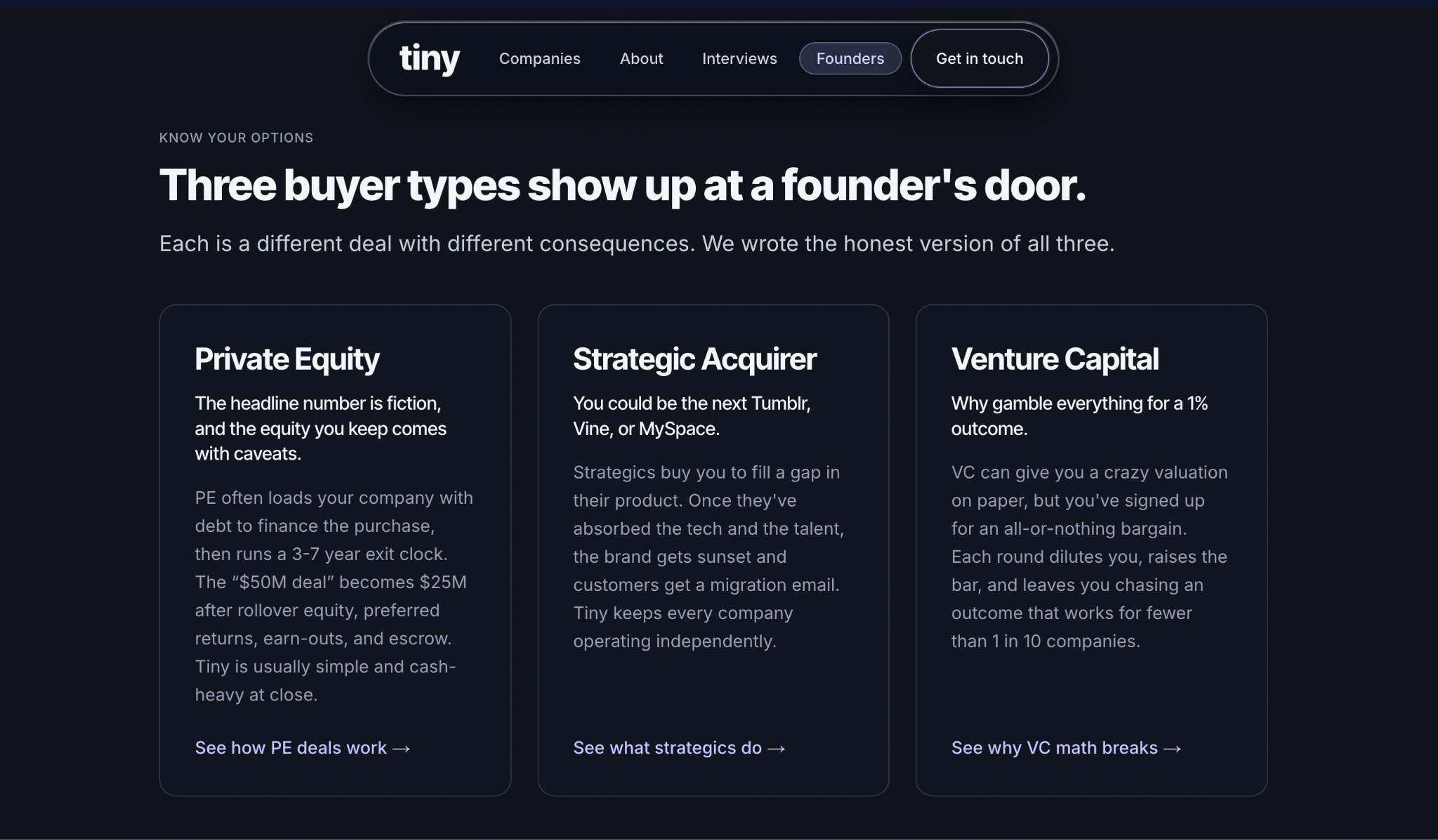
And in funny news, I think absolutely no one has made the case against all of the named buyers better than Tiny themselves, right on their own website (Tiny is the investment group that purchased 60% of Letterboxd in 2023 and is now selling). Their website has a wonderfully concise analysis of the future of Letterboxd with any of the named buyers:
They also explained why they thought Letterboxd was a good investment:
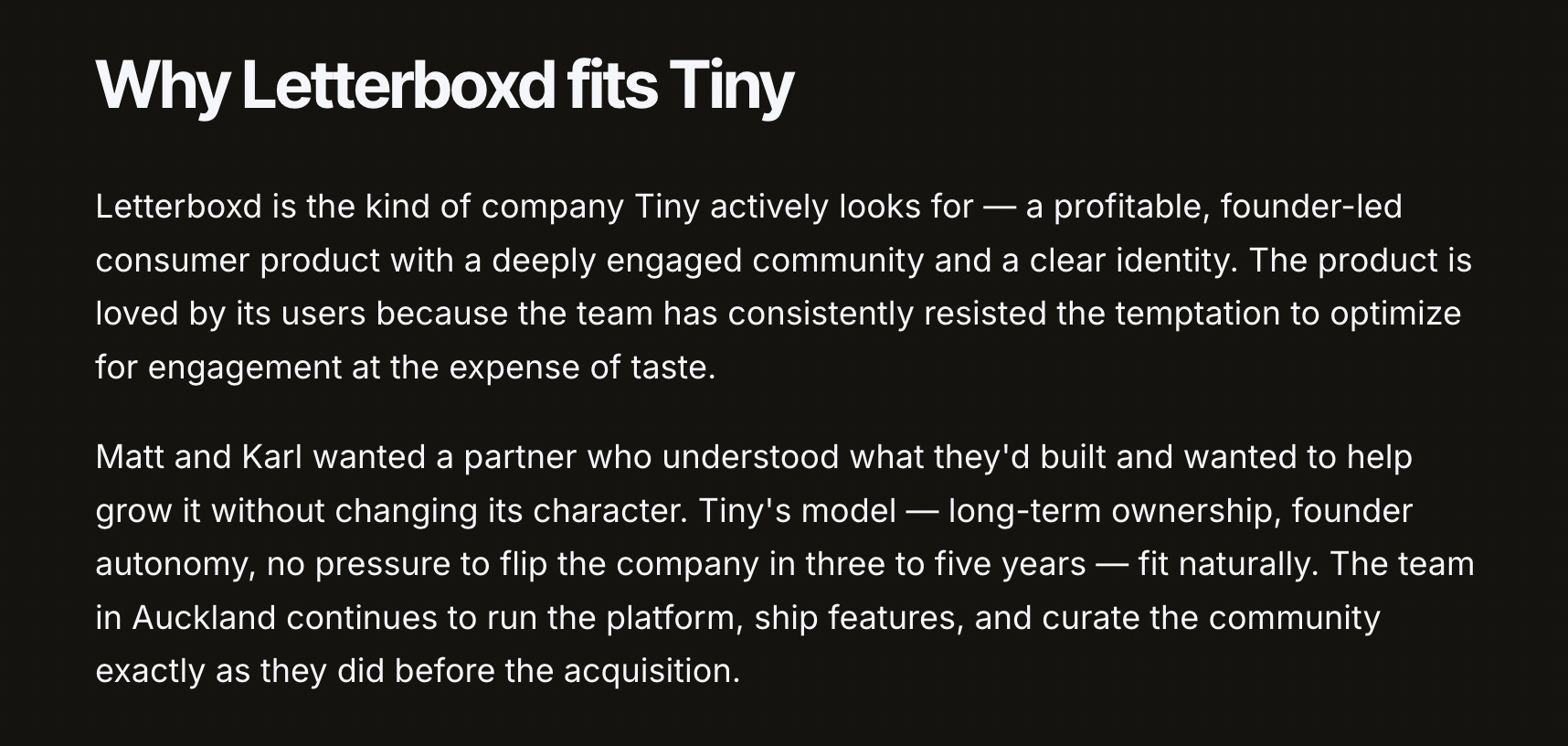
“[Letterboxd] is loved by its users because the team has consistently resisted the temptation to optimize for engagement at the expense of taste.”
And why the Letterboxd founders chose to sell 60% of their company to Tiny:
“Matt and Karl wanted a partner who understood what they’d built and wanted to help grow it without changing its character. Tiny’s model – long-term ownership, founder autonomy, no pressure to flip the company in three to five years – fit naturally.”
If we assess the situation using just Tiny’s own words, it becomes clearer that our bid is being built methodically to let us compete on more than one front. Because, let’s be realistic, PE firms are a dime-a-dozen. Plenty of investment groups can put together cash fast, but they don’t have the substance to match the speed. We prioritize substance over speed. We spent the past two months making sure we got the substance absolutely right.
Alex Rollins Berg: Letterboxd is already a profitable company. Profitability is a necessary and positive thing. Paint us a picture of what profitability looks like under the “englorification” (great word) you aim to bring about, versus the “enshittification” others might inflict?
Elizabeth Joyce: We all know that enshittification is what happens when a company begins to optimize for shareholder profits ahead of product quality or community. Cory Doctorow’s description of the process as it pertains to internet businesses is that as soon as online businesses take investor funding, it essentially sets a clock. They might have started out building a community that pleases its customers, but quickly they move towards seeking bigger dollars: instead of a few bucks from subscriptions they go after big bucks for advertising and data. First they optimize for engagement, which primes the pump for ads, which squeezes out some profit for shareholders but degrades the user experience. Eventually users tire of just scrolling through ads and they migrate elsewhere.
Englorification is our envisioning of the opposite process – a process in which we align investors’ interests with community interests by utilizing a community exit strategy. What that means is that instead of optimizing for a sale to one of the three groups in Tiny’s extremely helpful chart, you focus on creating a community so great the members want to own the company. Our long-term strategy is to run annual equity crowdfunding campaigns on Wefunder that enable platform users to buy shares of the company, and eventually buy out the early investors. That’s how you align incentives. When investors, the company, and the users are all pulling in the same direction, we believe we will see profitability increase sustainability because the users become part of the process.
If one of the other buyers decides to dump a huge amount of money into an acquisition but hasn’t figured out how to align incentives for their shareholders, the Letterboxd team, and Letterboxd users, we would worry for them they would essentially destroy the value of the asset they bought.
Alex Rollins Berg: I’m fascinated by the public benefit corporation as an alternative business model. Do you see it as a viable “exit strategy” from the enshittification doom loop we’ve been trapped in? If so, what other sectors would you like to see adopting it?
Elizabeth Joyce: I do! I want to see ALL sectors adopting it! I got into this a bit with Richard Rushfield the other day – in the 1970s, businesses in the U.S. took a hard turn away from behaving like members of society. Milton Friedman entitled his doctrine, “The Social Responsibility of Business is to Increase Its Profits” and wrote:
“The businessmen believe that they are defending free enterprise when they declaim that business is not concerned “merely” with profit but also with promoting desirable “social” ends; that business has a “social conscience” and takes seriously its responsibilities for providing employment, eliminating discrimination, avoiding pollution and whatever else may be the catchwords of the contemporary crop of reformers. In fact they are—or would be if they or any one else took them seriously— preaching pure and unadulterated socialism.”
So may I please be the one millionth person to say, fuck Milton Friedman. But he was successful in spreading this message and more than 50 years later we can see very clearly the outcome of this ethos. We see the result of businesses abandoning the concept of a social contract or even basic decency, and pursuing profit at all costs. When Friedman wrote his doctrine in 1970, wealth equality was at nearly record levels. That is not to say it was equitably distributed demographically: there were and are significant disparities by race, gender, disability, and more. However, the wealth differential between the wealthiest 1% of Americans and the lower half of Americans was a fraction of what it is today.
The beauty of the public benefit corporation entity structure is that it explicitly allows companies to prioritize their social mission alongside the pursuit of responsible profit. The public benefit entity alone doesn’t solve the problem of enshittification, but Intrinsic’s business model does. We have two classes of common stock, Class A and Class B. Class A stock is what angel investors receive for contributing larger amounts of capital. Class B stock is what employees and people who invest smaller amounts through Wefunder get. At the beginning, there are more shares of Class A stock issued than Class B, but over time, as the shares of Class B stock rise and the company buys back Class A shares, the company is able to provide the early investors with a successful exit, but it’s an exit to the community that uses and cares about the platform. That’s how we get out of the enshittification doom loop. And this model can be applied to any company that needs startup capital, and commits to finding investors who are willing to sign up for a gradual exit to the community instead of the quick exit that destroys businesses after sucking the lifeblood out of them.
Alex Rollins Berg: How can my readers support this courageous cause?
Elizabeth Joyce: The first thing we need to do is finish up the Seed&Spark campaign. The two most important things anyone can do today are to contribute to the campaign if that is feasible for you, and to share the campaign with people who care about the future of independent film. We especially want people to create TikTok videos because I am too old and librarian-adjacent for TikTok. 🙂
The benefit to people who support our Seed&Spark campaign is that when we are able to complete the legal work and open our Wefunder campaign, they will be the first invited to join. The SEC limits us to raising no more than $5 million in smaller-dollar investments, so we will only be able to allow a limited number of smaller-dollar investors to join each year. Again, to be very clear, that is because the SEC has that limitation. That is why it is necessary to build a coalition between the larger investors who align with the mission and the number of smaller-dollar investors the SEC will allow.
So please help us finish up the Seed&Spark so we can complete the legal work necessary to bring in the smaller investors, and even if you can’t contribute we are extremely grateful to everyone helping us get the word out!
People can share the below as an option on social media or in emails, or write their own text to go with the campaign link:
The Letterboxd sale is heating up and the only mission-driven bidder needs our help getting the word out about their campaign. Please read, support, and share!
https://seedandspark.com/fund/buyletterboxd
It is necessary for us to raise the legal funds for this part of the work if smaller investors want to be able to join for equity alongside our existing larger investors. I detailed this process extensively in this post for anyone who wants to get into the weeds of it, but we are running a very complex play and need a lot of legal expertise to make sure we run it perfectly. We have to make sure everything is done in compliance with SEC regulations, we have to pay for a financial audit, we have to pay lawyers to write investor documents and disclosures, etc.
The good news is that we are $7,835 from being greenlit on Seed&Spark, so we are in the strike zone. Raising that amount will enable us to complete the necessary legal work and hire a publicist so that in our next phase we can take this wide.
News Reel
Twelve states and the WGA have sued to stop the Paramount–Warner Bros. merger as an antitrust violation. “This proposed $110 billion merger, the largest in Hollywood history, would extinguish competition between Paramount and Warner Bros. and inflict substantial harm on movie theatres, basic cable distributors, and, ultimately, audiences nationwide," the filing alleges. “The merger combines two of the nation's five major film distributors, leaving only four to control over 85 percent of all wide-release theatrical films in the United States.”
When the House Is on Fire, Give Teenagers a Camera. 75 students from Van Nuys High School, Westbrook Academy, and Renaissance School for the Arts in Long Beach teamed up to make short documentaries that focus on their communities’ oral history, reports Film Independent. You can watch five of their entries here.
The Box Office Bounces Back: Gen Z, Surprise Hits and More Have Hollywood Banking on a $10 Billion Year: “I am constantly having conversations with studio heads, and you can sense an optimism that they haven’t felt in a long time,” says Seth Rogen. “It reminds me a little bit more of how it felt 15 years ago, in that there’s a belief that they can win again.”
Vidiots luring teens and tweens to the cinema this summer with “Movie Den,” a matinee repertory series offering $2 tickets and free popcorn. This summer’s lineup includes Phantom of the Paradise, Run Lola Run, and the criminally underseen Don’t Tell Mom the Babysitter’s Dead.
And now, this week’s Underexposed Movie Pick:
Night Nurse (2026, Georgia Bernstein)
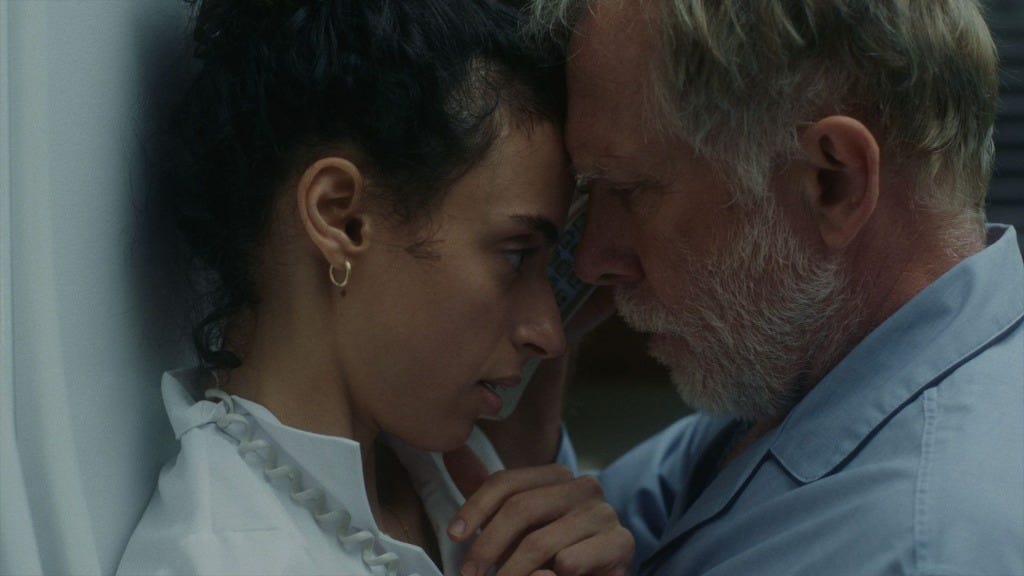
As Robert Altman showed us in his 1977 psychodrama Three Women, elder care is a gateway to dark, hallucinogenic places. Night Nurse, Georgia Bernstein’s bizarre and beguiling debut, centers on Eleni, a starry-eyed nurse who becomes entangled with Douglas, her mysterious patient.
Bernstein was inspired to write the script after her grandmother nearly fell for a phone scam, in which the caller (pretending to be her brother) claimed he needed money after a car accident. She was taken by the performance of the scammer, who made her grandmother feel “needed.” Fittingly, they shot a large portion of the movie in her grandmother’s house. I got interested in seeking out Night Nurse after critics called it a “gloriously deviant oddity” and “an unexpectedly tender neo-noir.” Night Nurse is now playing in select theaters.
That’s all for the free edition. Paid subscribers get access to Elizabeth Joyce’s Underexposed Guest Pick, and a bonus segment in honor of the World Cup, written by my Brazilian hooligan wife.
My World Cup Runneth Over

“Soccer is the most important thing of the least important things in life.” - Arrigo Sacchi, former Italian coach
Many are mourning the end of the World Cup. Though there was much suffering, it was also a beautiful (and necessary) moment of global togetherness, even if it unfolded under questionable leadership. Such is life these days. To keep the ball in the air a little longer, here's a list of soccer films curated by my grieving Brazilian wife.
